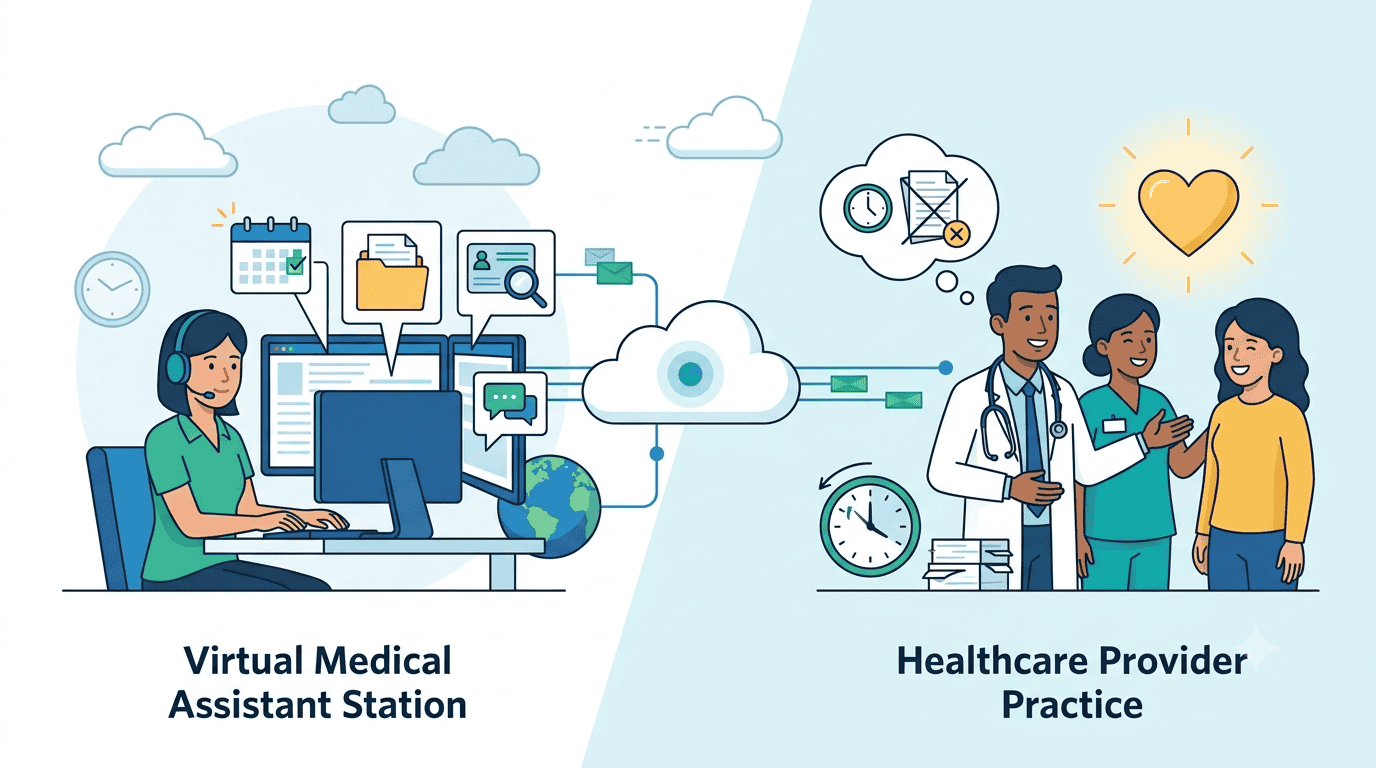
A virtual medical assistant is a remote professional who helps healthcare providers manage administrative, patient communication, and back-office tasks. They may schedule appointments, update patient records, verify insurance information, handle referrals, manage inboxes, and support medical billing workflows.
Unlike an in-office medical assistant, a virtual medical assistant usually does not perform hands-on clinical duties such as taking vital signs, drawing blood, or preparing patients for physical examinations. Their role is primarily focused on work that can be completed securely by phone or computer.
Medical practices use virtual support to reduce administrative workloads, improve patient response times, and give clinical staff more time to focus on patient care.
Quick definition
A virtual medical assistant is a remotely based healthcare support professional who handles administrative and non-hands-on tasks for clinics, physicians, dentists, therapists, and other healthcare organizations.
Common responsibilities include:
- Scheduling and confirming appointments
- Answering patient calls and messages
- Updating electronic health records
- Coordinating referrals
- Verifying insurance details
- Following up on forms and documentation
- Supporting billing and claims administration
- Managing provider calendars
- Organizing patient intake information
Businesses seeking trained remote support can work with Virtual Assistant Philippines, a brand that connects organizations with Filipino professionals experienced in administrative and specialized business functions.
What does a remote medical assistant do?
The exact responsibilities depend on the type of healthcare organization, the assistant’s experience, and the systems they are authorized to access.
A solo physician may need help answering calls and managing appointments. A larger clinic may assign a remote assistant to referrals, insurance verification, patient intake, or billing support.
Here are some of the most common duties.
Appointment scheduling and calendar management
A remote healthcare assistant can schedule, reschedule, and confirm appointments based on provider availability.
They may also:
- Maintain multiple provider calendars
- Send appointment reminders
- Contact patients about cancellations
- Fill openings from a waiting list
- Coordinate telehealth appointments
- Record scheduling notes
- Monitor missed appointments
Consistent scheduling support can reduce interruptions for reception staff and help patients receive faster responses.
Patient communication
Virtual support professionals can act as an initial point of contact for non-emergency patient inquiries.
Depending on their training and authorization, they may:
- Answer incoming calls
- Return voicemail messages
- Respond to approved portal messages
- Explain administrative procedures
- Provide appointment instructions
- Follow up on incomplete forms
- Route clinical questions to qualified staff
A virtual assistant should not diagnose conditions, provide medical advice, or make clinical decisions unless they hold the required professional qualifications and are legally authorized to do so.
Patient intake and records administration
Medical practices often spend considerable time collecting and organizing patient information before an appointment.
A remote assistant may help by:
- Sending intake forms
- Checking whether forms are complete
- Entering approved information into the practice system
- Updating demographic details
- Uploading documents
- Organizing electronic files
- Flagging missing information for staff review
Access should be limited to the information needed for the assistant’s assigned role.
Insurance verification
Insurance-related administration can be time-consuming, especially when staff must contact insurers or review eligibility information before appointments.
A trained assistant may support the process by:
- Confirming active coverage
- Checking basic eligibility
- Recording policy details
- Identifying missing insurance information
- Requesting copies of insurance cards
- Preparing verification notes
- Escalating coverage questions to billing staff
The assistant should follow the practice’s established procedures rather than interpreting coverage or guaranteeing that an insurer will pay a claim.
Referral coordination
Remote medical support can help keep referrals moving between providers, patients, and specialist offices.
Tasks may include:
- Preparing referral documentation
- Sending approved records
- Contacting specialist offices
- Tracking referral status
- Following up on missing information
- Updating patients on administrative progress
- Recording communications in the relevant system
This support can reduce delays caused by incomplete forms, missed messages, and unclear ownership.
Billing and claims support
Some virtual medical assistants have experience supporting revenue cycle processes.
They may help with:
- Entering billing information
- Reviewing claims for missing data
- Following up on unpaid balances
- Posting payments
- Preparing invoices
- Tracking claim status
- Organizing billing documents
- Sending approved payment reminders
Medical coding, billing decisions, and claims management may require specialized training. Practices should confirm a candidate’s qualifications before assigning complex financial or coding responsibilities.
How the remote role differs from an in-office assistant
The main difference is that a virtual assistant works remotely and generally focuses on tasks that can be handled through digital systems.
| Virtual medical support | In-office medical support |
|---|---|
| Works remotely | Works inside a healthcare facility |
| Handles administrative workflows | May handle administrative and clinical work |
| Communicates by phone, email, or portal | Communicates with patients in person |
| Manages records, schedules, and follow-ups | May prepare examination rooms |
| Cannot perform physical patient procedures remotely | May take vital signs or collect specimens |
| Uses secure online systems | Uses both physical and digital systems |
The U.S. Bureau of Labor Statistics describes traditional medical assistants as professionals who may perform both administrative and clinical duties, including scheduling appointments, recording medical histories, taking vital signs, and assisting with examinations. A remote assistant usually concentrates on the administrative portion of that work.
A virtual medical assistant is also different from a physician assistant. A physician assistant is a licensed healthcare professional who examines, diagnoses, and treats patients. A virtual assistant is normally a support professional and does not independently provide medical care.
Which healthcare organizations use remote assistants?
Virtual support can be useful across many areas of healthcare, including:
- Primary care practices
- Dental clinics
- Mental health practices
- Physical therapy clinics
- Chiropractic offices
- Medical specialists
- Telehealth providers
- Home healthcare organizations
- Medical billing companies
- Wellness clinics
- Outpatient facilities
The best tasks to delegate are usually repetitive, process-driven responsibilities that do not require physical access to the patient or independent clinical judgment.
Does remote healthcare support need to be HIPAA compliant?
A virtual medical assistant who accesses protected health information must work within the healthcare organization’s privacy and security framework.
HIPAA compliance is not created simply by hiring someone who describes themselves as “HIPAA trained.” Compliance depends on the complete working arrangement, including contracts, access controls, training, technology, policies, supervision, and security procedures.
The U.S. Department of Health and Human Services states that when a covered entity uses an outside person or company to perform services involving protected health information, that provider may be considered a business associate. A written business associate agreement may be required to define permitted uses of the information and the safeguards that must be followed.
Before granting access to patient information, a healthcare organization should consider:
- Whether a business associate agreement is required
- Which systems the assistant needs to access
- How user identities will be verified
- Whether multi-factor authentication is enabled
- How access will be removed when the engagement ends
- Whether devices and connections meet security requirements
- How information may be stored or downloaded
- Which communication channels are approved
- How suspected incidents must be reported
- Whether the assistant has completed appropriate training
Practices should consult qualified legal or compliance professionals about their specific obligations.
What are the benefits for a medical practice?
The main benefit is not simply lower labor costs. It is the ability to move recurring administrative work away from clinicians and in-office staff.
Potential benefits include:
More time for patient care
Doctors, nurses, and clinical staff can spend less time on scheduling, paperwork, and routine follow-ups.
Faster patient responses
A dedicated assistant can monitor calls, appointment requests, and administrative messages throughout the working day.
More consistent processes
Recurring tasks can be assigned to one person who follows documented procedures and keeps records updated.
Flexible staffing
Practices may begin with part-time support and increase hours as call volume, patient numbers, or administrative responsibilities grow.
Reduced pressure on reception staff
A remote assistant can take ownership of selected back-office workflows while onsite staff focus on patients arriving at the practice.
What should you look for when hiring?
Healthcare experience is valuable, but it should not be the only hiring criterion.
A strong candidate should demonstrate:
- Clear written and spoken communication
- Experience with healthcare administration
- Careful attention to detail
- Respect for patient confidentiality
- Familiarity with scheduling or records systems
- The ability to follow documented procedures
- Good judgment about when to escalate an issue
- Reliable internet access and a secure workspace
- Experience working with international teams
- A clear understanding of role boundaries
Ask candidates to explain how they would handle realistic situations. For example, you might ask what they would do if a patient requested medical advice, reported an urgent symptom, or asked them to change information in a record.
Their answers should demonstrate that they understand when to follow a process and when to escalate the matter to qualified clinical staff.
How to introduce remote support into your practice
Start with a small number of clearly documented responsibilities rather than transferring an entire administrative department at once.
A practical onboarding process may include:
- Identify repetitive administrative work.
- Separate clinical decisions from administrative tasks.
- Document each workflow.
- Define which systems the assistant may access.
- Set patient communication rules.
- Create an escalation procedure.
- Provide privacy and security training.
- Review performance and access regularly.
Practices considering dedicated support can learn more about hiring a medical virtual assistant for scheduling, patient communication, records administration, and other remote healthcare workflows.
Frequently asked questions
Can remote assistants speak directly with patients?
Yes. They can handle approved administrative communication, such as scheduling, reminders, intake follow-ups, and general office information. They should not give medical advice unless they are appropriately licensed and authorized.
Can they access electronic health records?
They may be given access when it is necessary for their assigned duties and permitted by the healthcare organization. Access should follow the principle of least privilege, meaning the assistant receives only the permissions required to complete the role.
Can they handle medical billing?
Some can support billing and claims administration. More advanced responsibilities, such as medical coding or complex denial management, may require specialized experience and training.
Are virtual medical assistants nurses?
Not necessarily. Some may have nursing or other healthcare backgrounds, but many are administrative professionals. Employers should verify credentials rather than assuming that a healthcare background includes a current clinical license.
Can one assistant support several providers?
Yes, provided the workload is realistic and responsibilities are clearly organized. The number of providers one person can support depends on appointment volume, call volume, task complexity, and required coverage.
What software can they use?
Depending on their experience, they may work with electronic health record systems, practice management platforms, secure messaging tools, scheduling software, billing systems, cloud phone systems, and productivity platforms.
The bottom line
A virtual medical assistant is a remote professional who helps healthcare providers manage administrative work, patient communication, records, appointments, referrals, insurance verification, and billing support.
The role is designed to support a healthcare team, not replace licensed clinicians or make independent medical decisions.
When tasks are clearly defined and patient information is protected through appropriate contracts, technology, policies, and supervision, remote medical support can help a practice operate more efficiently while giving onsite staff more time to focus on patients.
